Systems Engineering · Quicken Loans · 2019
Smart Lockers
A self-service tech distribution system—web portal, Raspberry Pi prototype, and 3D-printed hardware—built by two interns and presented to the SVP.
At a glance
- What
- A self-service smart-locker system for device distribution at Quicken Loans
- My role
- Intern — web portal, API, and the Raspberry Pi kiosk
- Outcome
- Prototype and pitch reached the SVP of Infrastructure
- Stack
- PHP · SQL · Python · Raspberry Pi · 3D printing
[BRIEF]The Story
It was my second summer as an IT intern at Quicken Loans. I wanted to do more than keep tickets moving—I wanted to build something that didn't exist yet.
My fellow intern Matthew Brown and I saw the same problem every day: people needed a loaner laptop, a mouse, a headset—and the process was slow, manual, and required chasing down IT. We set out to automate the entire workflow with a self-serve smart locker system, from the web portal to the physical hardware.
"Why wait for IT when you can serve yourself?"
0
Interns
Sam & Matthew
0
Working Prototype
Raspberry Pi + 3D print
0
Device Types
laptops, mice, keyboards, headsets
0
SVP Presentation
Infrastructure & Operations
[FLOW]Process
[SPEC]Context
Manual device distribution. An intern's chance to fix it.
At Quicken Loans, if your laptop broke or you needed a loaner mouse, you'd submit a ticket and wait. Sometimes hours, sometimes a full day. For a company moving at startup speed, that friction added up fast.
Matthew and I saw the opportunity: a self-service kiosk where employees request tech through a web app, get a unique PIN tied to their company RFID badge, walk up to a locker, scan their badge, type the PIN, and walk away with exactly what they need—no tickets, no waiting.
[TYPE]
Internship — Process Automation
[ORG]
Quicken Loans (now Rocket Mortgage)
[TOOLS]
PHP, SQL, Python, HTML/CSS, Bootstrap, Raspberry Pi, Raspian, 3D Printing
[YEAR]
Summer 2019
[TEAM]
Sam Bloch & Matthew Brown
The problem. Every IT department has it.
Slow manual distribution
Requesting a loaner device meant submitting a ticket, waiting for assignment, then physically tracking down the right person. Hours wasted.
No accountability chain
Once a device left the shelf, there was no automated way to track who had it, for how long, or whether it came back.
IT bottleneck
Every request required human intervention—even for simple peripherals like a mouse or headset. IT staff were overloaded with repetitive tasks.
Scale problem
Quicken Loans was growing fast. The manual process that worked for 500 people wouldn't work for 5,000.
[BUILD LOG] From concept to working prototype in one summer.
[BUILD]The Web Portal
Request tech. Get a PIN. Walk up and go.
I built the front-facing web application using PHP and SQL to power an interactive database, with HTML, CSS, JavaScript, and Bootstrap for the UI. Employees could browse available devices by category—laptops, mice, keyboards, headsets—and submit a request in seconds.
Upon submission, the system generated a unique 4-digit PIN tied to the user's company RFID badge. The confirmation screen told them exactly which floor, which locker side, and which locker number to visit.
[ARCH]Interactive System Diagram
Three layers. One seamless flow.
[INTERACTIVE] Click components to inspect · Run simulation to trace the full request flow
[DEPLOY] From proof-of-concept to physical prototype.
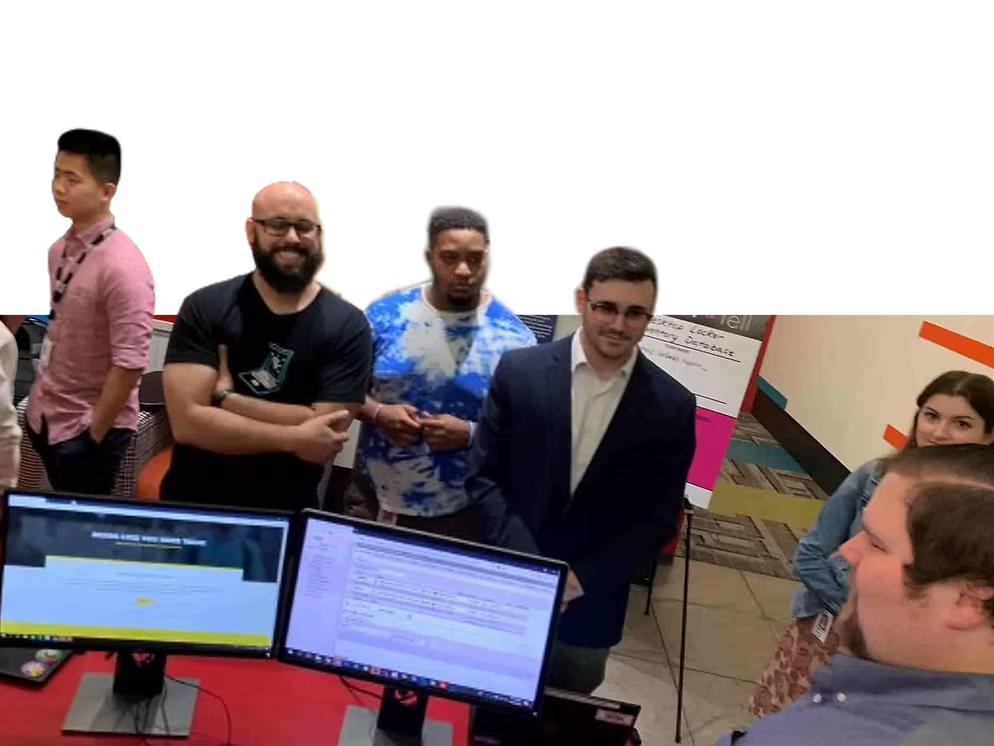
[05] Hack Week — presenting to the tech department
[HW]The Hardware
Beyond proof-of-concept. A real, working prototype.
Matthew had built the Python application controlling the locker logic. To go beyond a laptop demo, I helped transfer the entire script onto a Raspberry Pi running Raspian, connected to a touchscreen display and an RFID badge scanner.
Then we went further: I 3D-printed a custom enclosure for the Raspberry Pi and scanner, turning a tangle of wires and boards into something that looked—and felt—like a real product. It was a kiosk you could actually walk up to and use.
[DEMO]Video Walkthrough
See it in action.
[VIDEO] Full prototype walkthrough — web portal to physical kiosk
"Two interns. One summer. An SVP meeting."
[SHIP]The Presentation
From hack week to the C-suite.
We presented the smart locker system to Quicken Loans' entire technology department during Hack Week—a company-wide event where teams demo passion projects and experimental builds.
The reception was strong enough that we landed a meeting with the Senior Vice President of Infrastructure and Operations to present our work. For two summer interns, getting 30 minutes with the SVP to pitch a project we'd built from scratch was the validation that this wasn't just a cool demo—it was a real solution to a real problem.
[LOG]Key Decisions
PHP + SQL for the web portal
PHP gave us rapid server-side rendering and SQL provided the relational database we needed to track devices, users, PINs, and locker assignments in real time.
RFID + PIN dual authentication
A badge scan alone isn't secure enough. Adding a unique PIN per request meant even if someone found a badge, they couldn't access the locker without the matching code.
Raspberry Pi over a full PC
Cost, size, and GPIO access. The Pi could run the Python script, drive a touchscreen, and interface with the badge scanner—all for under $50 in hardware.
3D-printed enclosure
We wanted the prototype to feel real, not look like a science fair project. A custom 3D-printed case turned a bare circuit board into a credible kiosk.
Hack Week as a launch pad
We timed our build to align with Hack Week, giving us a built-in audience of the entire tech department—and a path to leadership visibility.
[REFLECT] What building real hardware taught me about building software.
[POST]What I Learned
Hardware forces you to think differently.
Software bugs are fixable with a deploy. Hardware bugs mean re-soldering, reprinting, or rewiring. Building a physical prototype taught me to plan more carefully and test earlier.
Complementary skills multiply output.
Matthew was strong in Python; I was strong in web development. Rather than both doing everything, we divided clearly and taught each other along the way. The project was better for it.
A demo is worth a thousand decks.
We could have pitched the concept with slides. Instead, we built a working prototype that people could touch. That's what got us from Hack Week to the SVP's office.
Intern projects can have real impact.
We weren't asked to build this. We identified the problem, proposed the solution, and built it ourselves. The best internship work comes from initiative, not assignment.
[ROLE]My Role
Team
Sam Bloch & Matthew Brown — IT Interns, Quicken Loans
Sam's Contributions
→ Built the entire web application — PHP, SQL database, HTML/CSS/JS front-end with Bootstrap
→ Designed the user flow: browse → request → PIN generation → locker assignment
→ Helped transfer the Python script onto Raspberry Pi with touchscreen and badge scanner
→ 3D-modeled and printed the custom enclosure for the kiosk hardware
→ Co-presented at Hack Week and to the SVP of Infrastructure & Operations
Matthew's Contributions
→ Developed the Python application controlling locker logic and device inventory
→ Built the REST API connecting the web portal to the physical hardware
→ Taught Sam Python fundamentals throughout the project
[TIME]Timeline
Early Summer
Identified the problem. Pitched the concept to our manager. Got the green light to build.
Weeks 1–3
Built the web portal (PHP/SQL) and API (Python). Parallel development with daily syncs.
Weeks 4–5
Connected the web app to the API. Built the Raspberry Pi kiosk with touchscreen and badge scanner.
Week 6
3D-printed the custom enclosure. Integrated all components into a working prototype.
Hack Week
Presented to the entire technology department. Landed an SVP meeting to showcase the system.